← All products
Content site · AI risk and compliance
A compliance desk for AI rules and risk
A compliance desk for the rule book every AI company now has to follow. Two new briefings every weekday, in two editions, on what the law requires, by which date and what to do about it, with every date and article number checked against the legal text before it goes live. Compliance is a budget line every AI company has to fund, and this site speaks straight to the people who hold it.
Writes aboutRegulationAssuranceAgent securityIncidentsWritten for compliance officers, lawyers and product owners shipping AI.
One-time price$1,500
Buy nowThe finished site with its full archive, the engine that keeps writing it and a step-by-step guide to run everything on your own domain.
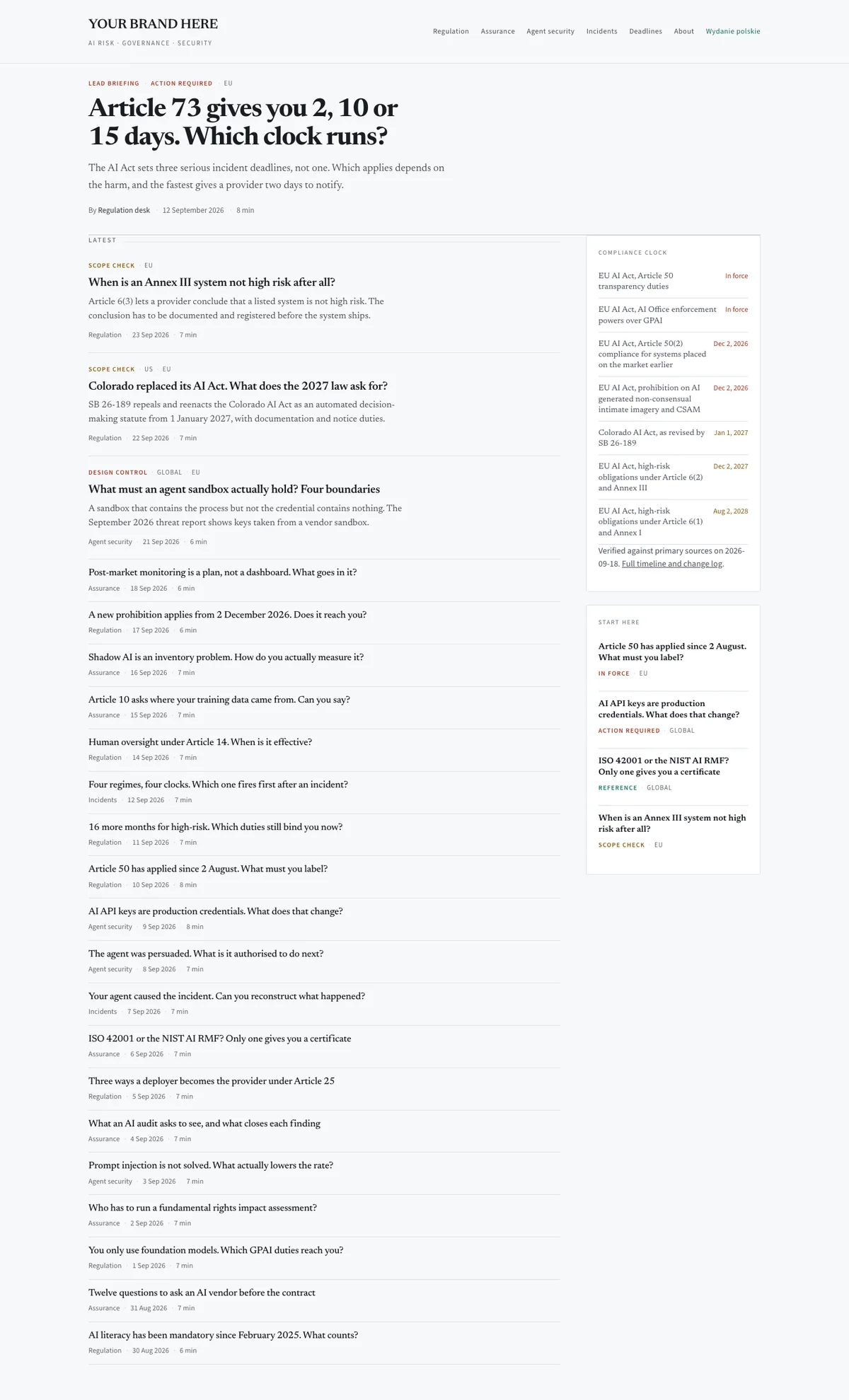
Front page as of September 23, 2026. The engine adds new articles here every weekday, so the live site has already moved on.
- Publishes
- 2 new briefings every weekday
- Article length
- 4,000 to 9,000 characters, 700+ words
- Running for
- 59 days
- Editions
- 2 editions, each written originally, not translated
- Editorial approval
- None: 39 automated checks decide
Why a site that runs itself is worth owning
One payment, then it works for youMost sites die the week their owner gets busy. This one never gets busy. It keeps publishing, keeps getting indexed and keeps building an archive that search engines and AI assistants can find, every weekday, whether you look at it or not.
One payment, yours outright
$1,500 once. No subscription to me, no revenue share. The site, the content and the engine are yours, on your own accounts.
It never stops publishing
New, fully sourced articles land every weekday without a writer, an editor or a meeting. The rhythm most publishers pay a whole team for is already running.
Built to be found
Every article is shaped for search and for AI answers: question headings, sourced tables, FAQs, structured data and clean sitemaps. Readers can arrive from search without paid promotion.
An asset that compounds
Every weekday adds pages that keep working for you. The archive grows, the reach grows, and so does what the site is worth to the next buyer.
Built for search, article by article
What every article must passSearch engines and AI assistants reward pages that answer a real question clearly, back it with sources and are easy for machines to read. Every article is written to that standard, and it only goes live once it passes.
Long form, not filler
700 words and up, typically 4,000 to 9,000 characters. The opening answers the question in under 95 words, and no paragraph runs past 95.
Headings people search for
Four to six section headings phrased as the questions readers actually type, each with its own anchor link.
Proof on the page
At least two tables with sourced captions, a dozen or more figures and at least three cited sources, credited to the original publisher.
An FAQ that answers first
A short FAQ where every answer opens with the answer itself, marked up as FAQ structured data.
Structured data everywhere
Article, FAQ, breadcrumb, organization and website data on every page, with every source listed as a citation.
Titles and snippets that fit
Titles and descriptions cut to search-friendly length, a canonical address, social cards and a 1200 by 630 preview image for every article.
Links that keep readers moving
Every article links to at least two related ones inside its own text, so readers and crawlers keep moving through the archive.
Open to AI search, fast by design
Sitemaps with real dates, a feed, an llms.txt summary, AI crawlers explicitly welcome, static pages, self-hosted fonts and long caching.
What a site like this can earn
Ways owners make it payReaders who arrive searching for answers in a niche are the most valuable readers there are, because businesses pay to reach them. Here is how owners turn that into income, and every route works on a site you own outright.
Display advertising
Plug in Google AdSense or another ad network and earn from every page view.
Direct banner sales
Sell banner space straight to companies in the niche: AI tool vendors, platforms, compliance and security firms. Direct deals usually pay far more than networks.
Sponsored articles
Publish clearly labelled sponsored pieces for vendors who want to reach exactly these readers, written to the same sourcing standard.
Affiliate revenue
The comparison tables name real tools and services. Affiliate links on them earn a commission on every sign-up they send.
Leads for your own business
Readers are engineers, founders, lawyers and compliance officers. A consultancy, agency or software company can turn that traffic into clients.
Your own products
Put your own guide, template, course or tool in front of readers who already trust the site, and keep every dollar it earns.
Everything $1,500 gets you
For about what a handful of commissioned articles would cost, you take home the whole newsroom and the machine that keeps it running.
- A finished, professional site: the design, every page and the full archive of articles, which keeps growing every weekday right up to the day you take over.
- The complete publishing engine, ready to run on your side: it finds what readers are searching for, researches it, writes, fact-checks and publishes on its own every weekday.
- SEO and AI search built into every article, so readers can find the site from day one without paying for promotion.
- A step-by-step launch guide: connect your own domain and hosting, switch the engine on, and it keeps publishing.
- A guide to measure your readers, with Google Analytics or other tools connected on request, so you have real numbers to show advertisers.
Buy it. Switch it on. It publishes. Readers arrive. Advertisers follow.
What it costs to run
After the one-time payment the running costs are small and entirely in your hands. The launch guide walks you through every account.
- AI subscription
- One monthly plan I tell you exactly which one.
- Hosting
- Free, or a few dollars a month
- Domain
- About $10 to $15 a year
- Reader analytics
- Guide included Google Analytics connected on request.
How the engine works
The same engine runs bothNobody writes these sites by hand and nobody approves a draft. Every weekday a scheduled job wakes up, checks that what it is about to publish is still true, fixes it or drops it, passes 39 checks and goes live. This is the whole loop, as it runs today.
It wakes on a timer
Each edition has its own slot every weekday, with a random delay so the rhythm never looks mechanical. Before anything else it reads the day's history and stops if the article already went out, so nothing is ever published twice.
It decides what readers need
Topics come from real demand, not guesses. A topic enters the queue only after a demand test: someone has this problem today, and the exact phrase they would search for can be written down, with the date it was checked and the result. Anything that overlaps an existing article is rejected.
It writes ahead
The engine keeps a queue of finished drafts. When two or fewer are left, it writes the next batch on its own: six articles for an English edition, four for the second language, each one checked against everything already published.
It re-checks the facts before publishing
A freshness gate runs on the article at the top of the queue. It pulls out every number, price, model version, legal date, article number and threshold and verifies each one online again. Small drift is corrected in the text, the takeaways, the FAQ and the sources. If the main claim is no longer true, the article is held back: it goes to the end of the queue with the reason written down, and the next one takes its place.
It writes to a strict house style
Every article opens in under 95 words and carries key takeaways, four to six sections phrased as the questions readers ask, comparison tables with their data source in the caption, a short FAQ and a method and sources section. Every number needs a source, the first publisher gets the credit, and nothing is invented to fill a gap.
It audits the finished page
The built page is audited, not the draft: structure, word counts, tables, numbers, FAQ, sources, structured data and every meta tag. Anything below 39 out of 39 is fixed, rebuilt and audited again. A second audit covers the whole site: broken links, canonical addresses, preview images, structured data and the sitemap.
It dresses the article for sharing
A 1200 by 630 preview card is drawn for every article from its own title and section, so links look finished wherever they are posted. Structured data describes the article, its FAQ, its breadcrumb and every source it cites.
It ships and confirms
The engine commits, builds and deploys the static site, then checks that the new page actually answers on the live address. The sitemap carries real article dates, the feed updates, and AI search crawlers are explicitly welcome, with an llms.txt summary written for them.
39 checks on every article
Nothing goes live below a perfect score. A failed check is fixed and the page is audited again.
- One H1, four to six question headings, every section anchored
- At least 700 words, no paragraph over 95 words
- At least two tables, each caption naming its data source
- At least 12 numbers in the text, takeaways built on figures
- A FAQ that answers in its first sentence
- At least three cited sources
- Article, FAQ, breadcrumb, organization and website structured data
- Title and description lengths, canonical, social cards, dates, author and section